


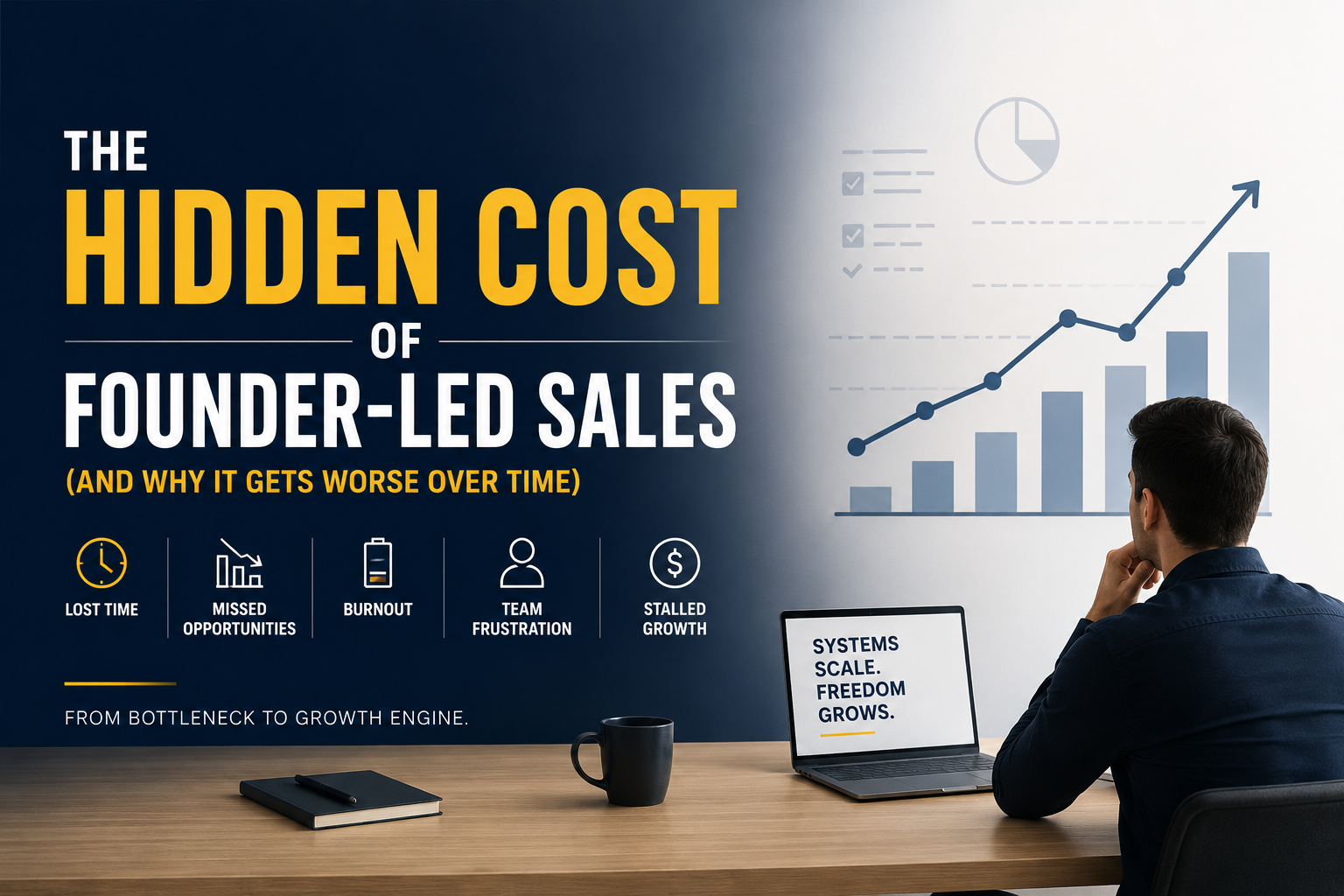
The Hidden Cost of Founder-Led Sales (And Why It Gets Worse Over Time)
Founder-led sales can feel like a badge of honor.
In the early days of building a business, it makes perfect sense. As the founder, you know your product inside and out, understand your customers better than anyone, and can close deals with confidence.
But what begins as a competitive advantage eventually becomes the biggest obstacle to growth.
The true cost of founder-led sales isn’t just the hours you spend on sales calls. It’s the impact on your freedom, profitability, team development, and ultimately, your company’s ability to scale.
Let’s explore why this happens—and how successful businesses make the transition.
Why Founder-Led Sales Works in the Beginning
For early-stage businesses, founder-led sales is often the fastest path to gaining traction.
Founders naturally have several advantages:
- Deep product knowledge
- Strong customer relationships
- The ability to handle objections instantly
- Passion and credibility that are difficult to replicate
These strengths help win those crucial first customers and validate the business.
However, they aren’t designed to support long-term growth.
As your company expands, sales become more complex. More leads enter the pipeline, buying decisions involve multiple stakeholders, sales cycles grow longer, and customers expect consistent communication.
Without realizing it, the founder slowly becomes the entire sales system.
And that’s where growth begins to stall.
The Hidden Costs Most Founders Overlook
Remaining dependent on founder-led sales creates costs that compound over time.
1. Missed Revenue Opportunities
There are only so many conversations one person can have.
While you’re focused on closing one deal, several others may be waiting for follow-ups or slipping through the cracks. Limited capacity means lost revenue.
2. Founder Burnout
Running a business already requires balancing product development, operations, hiring, finance, customer success, and leadership.
Adding every important sales conversation to that list creates an unsustainable workload.
Eventually, something has to give.
3. Shrinking Profit Margins
When sales rely entirely on the founder’s time, growth becomes expensive.
Instead of building repeatable processes, every new customer requires more personal involvement. Sales stop being a scalable function and become a constant drain on executive time.
4. Team Frustration
Talented salespeople want clear direction and repeatable processes.
Without documented systems, they depend on the founder for decisions, approvals, and guidance.
This creates confusion, slows performance, and often leads to employee turnover.
5. Stalled Business Growth
Perhaps the greatest cost is the invisible ceiling placed on your business.
If sales only happen when you’re involved, the company can never grow beyond your personal capacity.
Growth becomes limited by your calendar.
The Shift: From Founder-Led Sales to System-Led Sales
Breaking free from founder-led sales isn’t about working harder.
It’s about building systems that allow your business to grow without relying on one individual.
A scalable sales engine includes:
- A clearly defined sales process from lead generation to closed deal
- Consistent accountability across the sales team
- Structured outreach and follow-up workflows
- CRM-driven visibility into every opportunity
- Clear performance tracking using measurable KPIs
- Repeatable processes that work whether the founder is involved or not
Instead of relying on memory and instinct, your sales organization begins operating with clarity and consistency.
What Happens When Sales Runs on Systems
When you replace founder dependency with structured sales systems, the entire business benefits.
Your sales team knows exactly what to prioritize every day.
Pipeline reviews become focused, data-driven, and productive.
Your CRM becomes a reliable source of truth instead of a collection of incomplete notes.
Sales cycles become shorter because follow-ups happen consistently.
Conversion rates improve because every opportunity follows a proven process.
Most importantly, the founder gains the freedom to focus on leadership, strategy, partnerships, and scaling the business—instead of chasing every deal.
Final Thoughts
Founder-led sales is an excellent way to start a business.
But it isn’t how great businesses scale.
The companies that achieve predictable, sustainable growth don’t depend on one person’s ability to sell. They build repeatable systems that consistently generate revenue.
If you’re still the primary salesperson in your business, ask yourself one question:
Is your company growing because of you—or can it grow without you?
The answer will determine how far your business can scale.
Ready to Build a Scalable Sales Engine?
If you’re ready to eliminate founder dependency and create a sales system that delivers predictable growth, we’re here to help.
Get Your Sales Growth Assessment today and discover how to transform your sales process into a scalable growth engine.