

What a Real Sales System Looks Like (And Why Most Companies Don’t Have One)
Every founder wants predictable, consistent revenue growth.
Yet surprisingly few businesses have a sales system capable of delivering it.
Instead, many companies rely on a handful of high-performing salespeople, a CRM filled with outdated information, and a sales process that exists mostly in the founder’s head.
It may work for a while—but it’s not scalable.
Without a structured system, sales become unpredictable, onboarding becomes difficult, and growth depends on individual effort rather than repeatable processes.
Here’s what a real sales system looks like—and why it’s one of the most valuable investments a growing business can make.
The Difference Between People-Driven Sales and System-Driven Sales
Many businesses grow because they have talented salespeople.
Those individuals know how to build relationships, handle objections, and close deals.
But relying solely on talent creates risk.
When your business depends on people instead of processes, problems quickly emerge:
- Top performers leave, and revenue drops with them.
- Training new sales hires takes months.
- Every salesperson develops their own way of selling.
- Forecasting becomes inaccurate.
- Results fluctuate from month to month.
A real sales system changes the equation.
Instead of relying on individual talent alone, the system drives performance.
People follow a proven process.
Results become consistent, measurable, and scalable.
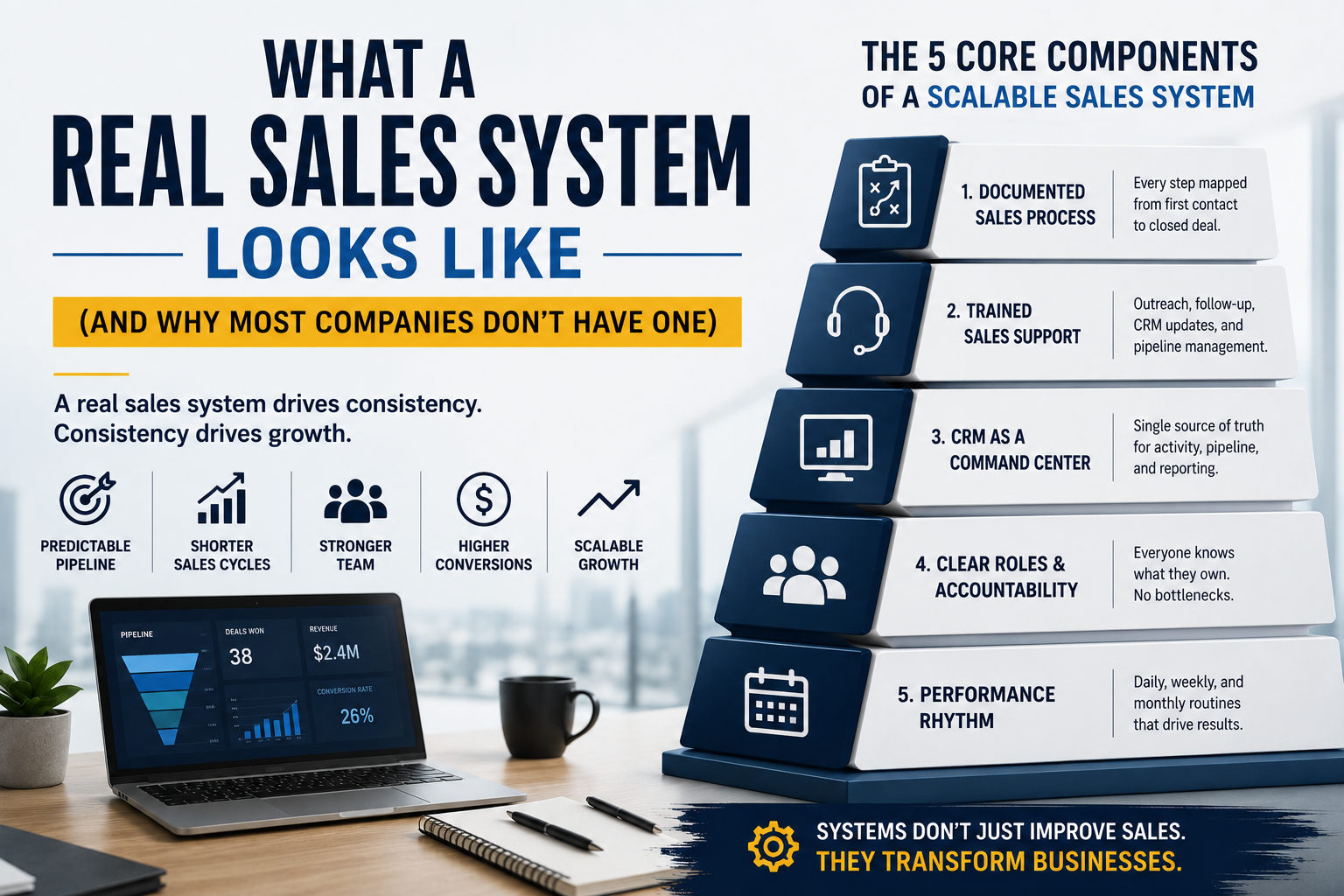
The Five Core Components of a Scalable Sales System
Building a predictable sales engine requires more than hiring great salespeople.
It requires building the infrastructure that supports consistent execution.
1. A Documented Sales Process
Every stage of the customer journey should be clearly defined—from the first conversation to the signed contract.
Your sales team should know:
- What happens at every stage
- When to move opportunities forward
- Which questions to ask
- What success looks like
A documented process removes guesswork and makes onboarding much faster.
2. Dedicated Sales Support
High-performing salespeople shouldn’t spend their day updating CRMs or chasing administrative tasks.
A strong sales system includes dedicated support for:
- Prospect outreach
- Lead follow-up
- CRM updates
- Meeting scheduling
- Pipeline management
This allows account executives to focus on what they do best—building relationships and closing deals.
3. CRM as the Command Center
Many companies treat their CRM as little more than a contact database.
A real sales organization uses its CRM as the central operating system for revenue.
Your CRM should provide complete visibility into:
- Sales activities
- Pipeline health
- Conversion rates
- Follow-up history
- Revenue forecasting
When everyone works from the same source of truth, decision-making becomes faster and more accurate.
4. Clear Roles and Accountability
One of the biggest causes of missed opportunities is uncertainty.
Who’s responsible for qualifying leads?
Who owns follow-up?
Who updates the CRM?
Who moves deals to the next stage?
A scalable sales system answers these questions clearly.
Every team member understands their responsibilities, reducing delays and eliminating bottlenecks.
5. A Consistent Performance Rhythm
Great sales organizations don’t wait until the end of the month to review results.
They operate on structured routines.
That includes:
- Daily activity tracking
- Weekly pipeline reviews
- Monthly performance analysis
- Ongoing coaching and feedback
These regular checkpoints help identify problems early and keep the entire sales team aligned.
Why Most Companies Never Build This
Building a sales system requires time, discipline, and expertise.
Unfortunately, most founders are already juggling product development, operations, hiring, customer success, and business strategy.
As a result, sales become reactive instead of intentional.
Many companies find themselves:
- Managing sales one deal at a time
- Hiring new representatives without documented processes
- Hoping marketing will solve declining revenue
- Constantly firefighting instead of improving systems
Without a repeatable framework, sales always feel chaotic.
Growth becomes unpredictable.
What Happens When You Build a Real Sales Engine
When your sales organization runs on systems rather than individual effort, everything changes.
Every lead receives timely follow-up.
Your CRM accurately reflects every opportunity.
Sales cycles become shorter because the process is standardized.
Pipeline forecasting becomes more reliable.
Sales managers spend less time solving operational issues and more time coaching performance.
Most importantly, the founder is no longer required to personally drive every important sale.
The business gains something far more valuable than higher revenue.
It gains freedom.
Growth becomes controlled, scalable, and repeatable.
Final Thoughts
Most companies don’t actually have a sales problem.
They have a systems problem.
A structured sales engine doesn’t just improve conversions—it creates predictability, accountability, and sustainable growth.
The businesses that consistently outperform their competitors aren’t necessarily generating more leads or hiring better salespeople.
They’re operating with better systems.
If your business still depends on founder involvement or inconsistent sales processes, now is the time to build the foundation that allows revenue to scale.
Ready to Build a Sales Engine That Scales?
If you’re ready to replace sales chaos with a structured, repeatable system that drives predictable revenue, we’re here to help.
We help B2B technology companies design scalable sales engines that improve execution, strengthen accountability, and eliminate founder dependency.
Get Your Sales Growth Assessment today and discover how a real sales system can unlock your next stage of growth.